Metro Detroit sits closer to Ontario's biggest ski resort than to most of northern Michigan's — a fact that surprises Michiganders every winter. Blue Mountain, on the shore of Georgian Bay, is a border crossing and an afternoon's drive from Detroit, and it offers something no drive within Michigan does: a full pedestrian resort village, Ontario's largest lift system, and whole-cabin lodging built for groups. Here is the trip, honestly laid out.
The crossings and the route
Two border options serve the Detroit side:
- Port Huron–Sarnia (Blue Water Bridge): I-94/I-69 to Port Huron, across to Sarnia, then Highway 402 east and northeast through southwestern Ontario toward Georgian Bay. Both border stations run 24 hours. For most Metro Detroit and northern-suburb starting points, this is the natural line.
- Detroit–Windsor (Ambassador Bridge or the tunnel): Crosses downtown-to-downtown, then Highway 401 east before turning north. It suits departures from the city core, at the cost of more urban miles.
Either way, plan roughly four and a half to five and a half hours door-to-door depending on your crossing, the border queue, and winter conditions. The final approach runs through Ontario farm country into the Niagara Escarpment — when the ridge appears above the bay, you have arrived.
Paperwork, in one paragraph
U.S. citizens driving into Canada need a WHTI-compliant document: a passport book, passport card, NEXUS card, or an Enhanced Driver's License — which Michigan issues, making it one of the few states where your driver's license alone can carry you across. No visa is involved for visits; kids need their own documents, and if you are bringing the dog, carry proof of rabies vaccination. Check the official crossing guidance close to your trip for anything current.
What Michigan skiers find at Blue Mountain
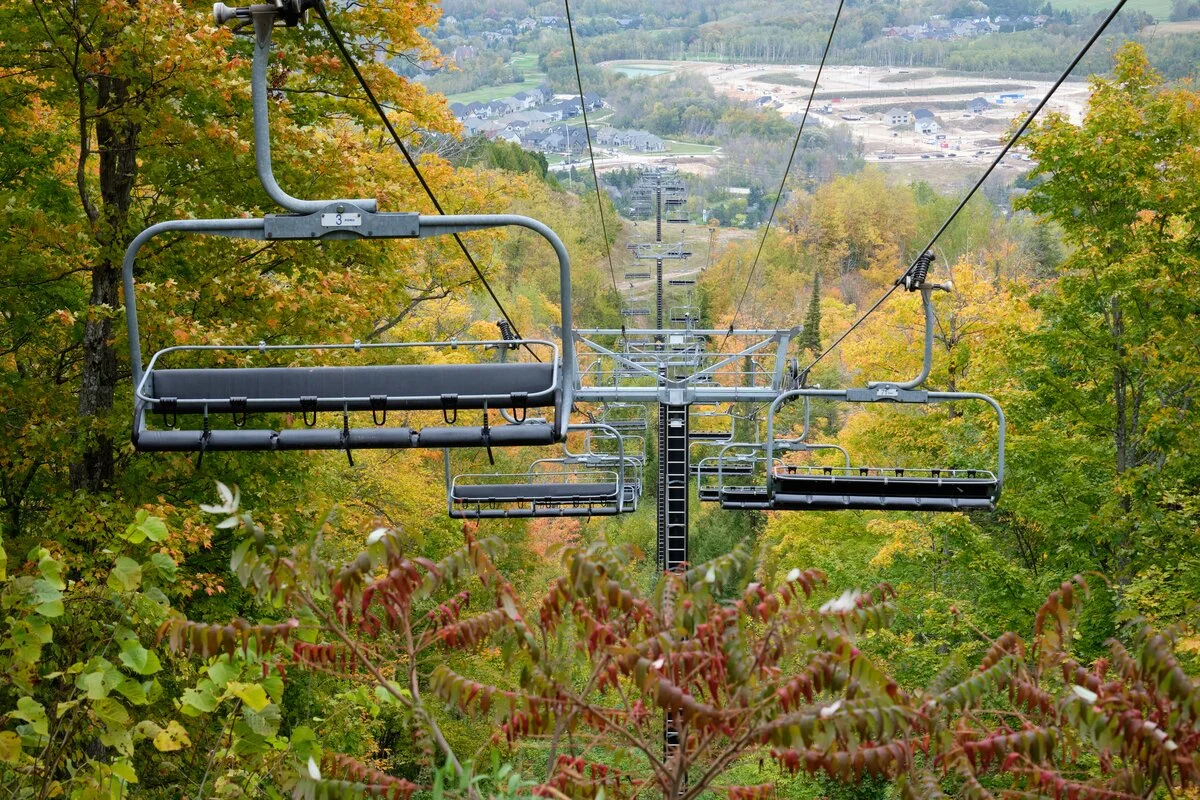
The mountain itself will read familiar to anyone who skis the Midwest — escarpment vertical rather than Rocky Mountain vertical — but scaled up: Ontario's largest resort by skiable terrain and lift network, with long cruisers off the top of the ridge and Georgian Bay filling the horizon. What has no Michigan equivalent is the base: a true walk-everywhere resort village of restaurants, bars, patios, and shops at the bottom of the lifts, running all evening. Après does not require a car here. The first-timer's guide covers the layout, and the season guide covers when the snow is best.
Cabin lodging, the way Michigan groups mean it
Michigan search habits say "cabin" where Ontario says "chalet" — same idea, and our version of it is ten full houses rather than rooms: 4–5 bedrooms each, sleeping 10 to 14, with a private year-round hot tub, full kitchen, and gas fireplace, eight of them side by side a 10-minute walk from the Village. For a carload-or-three ski crew, one booking replaces a floor of hotel rooms — the math is in the group lodging guide, and the cabin rentals page speaks fluent Michigander. One practical note for cross-border budgeting: rates are in Canadian dollars, which generally works in the U.S. visitor's favour — check the day's exchange rather than any figure printed anywhere.
Making the drive worth it
A border trip earns three-plus nights. The pattern that works for Michigan groups: leave early on day one, ski the afternoon you arrive or the full next day, build in one non-ski day (Scandinave Spa, the Village, snowshoeing — the no-ski guide has the full list), and cross back rested. For the border-crossing details in the other direction and the full U.S.-visitor practicalities — payment, tipping, driving in Ontario — see the American visitor's guide.
Or call us at (416) 203-2057